A convenient sample
Blood is the current foundation. Urine and saliva may support future applications where the science and validation justify the sample type.

microRNAs are small biological molecules that help regulate gene activity. When cell activity changes, the relative levels of microRNAs circulating in blood can change too. Their role in gene regulation was recognized by the 2024 Nobel Prize in Physiology or Medicine. miRoncol measures hundreds together and uses AI to identify disease-associated patterns supported by validated research.
The scientific premise: changes in regulatory patterns may add context before, alongside or beyond many familiar downstream biomarkers.
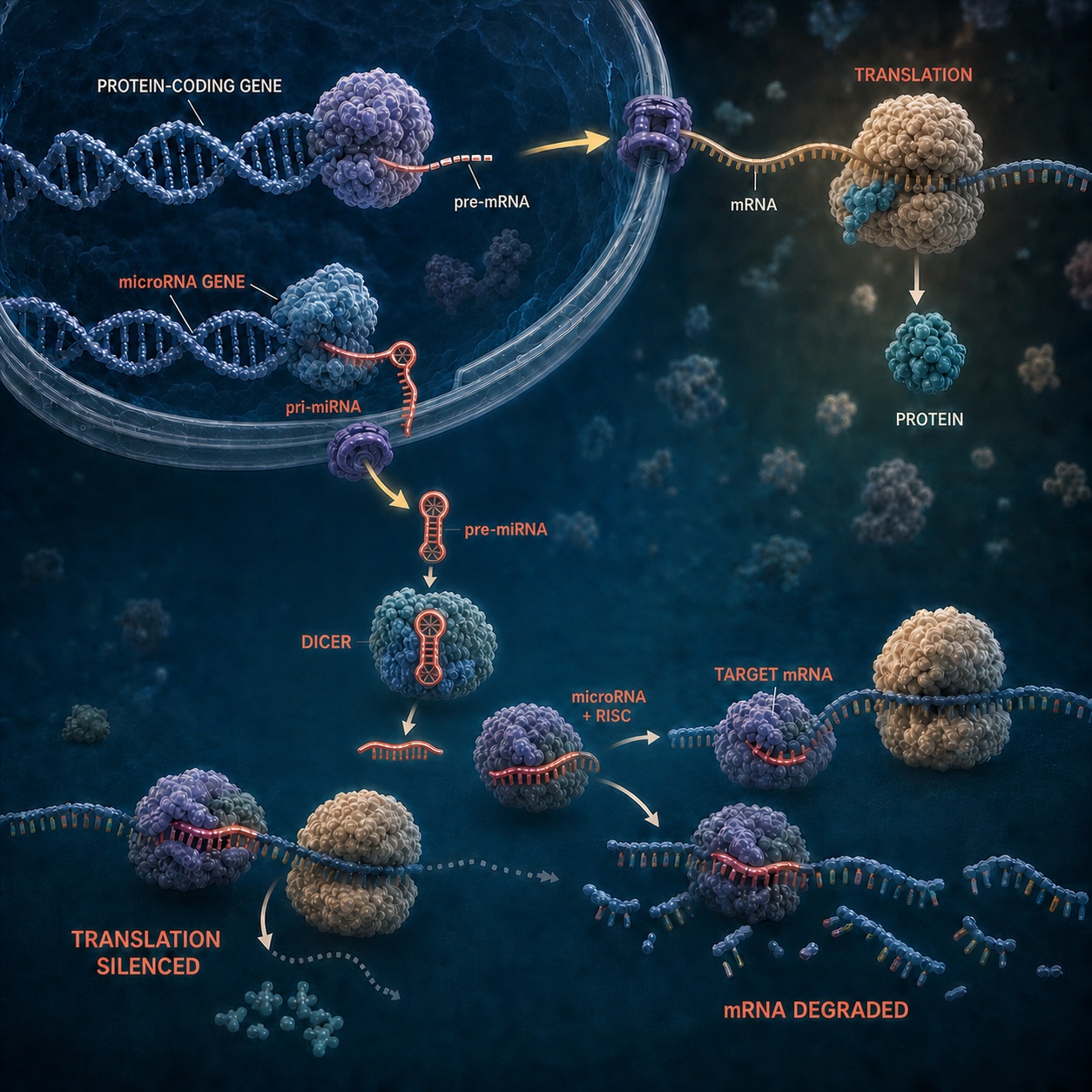
The discovery of microRNA and its role in post-transcriptional gene regulation was recognized by the 2024 Nobel Prize in Physiology or Medicine. This gives the field a powerful scientific foundation. It also opens a much larger question: what can be learned when microRNA patterns are measured over time?
In plain language: this study examined whether cell-free microRNA patterns in a blood sample could distinguish multiple cancers from non-cancer samples.
Zhang J, Rui H, Hu H. Scientific Reports 14, 22136.
Read the paper ↗In plain language: this earlier study developed and evaluated the model that became the research starting point for miRoncol’s blood-based approach.
Zhang A, Hu H. Cancers 14(6), 1450.
Read the paper ↗A single microRNA does not tell the whole story. miRoncol measures hundreds together and uses AI to identify disease-associated patterns supported by validated research.

miRoncol uses AI to analyze how hundreds of microRNAs appear together. The resulting pattern can be evaluated against validated disease-associated research and, with repeated profiles, against a person’s developing history.
One platform can support both broad research and application-specific assays. The method changes with the question; the microRNA intelligence layer connects the work.


Blood is the current foundation. Urine and saliva may support future applications where the science and validation justify the sample type.
Next-generation sequencing captures a broad microRNA profile. Stored data can be revisited as research develops and new patterns become relevant.
AI-assisted analytics evaluate relationships across a panel and, over time, within an individual’s developing biological history.
Targeted PCR assays can measure established sets of microRNAs for a more focused, scalable and potentially lower-cost application.

“NGS preserves the possibilities. PCR provides the focus. Longitudinal data creates the history.”
A current-state test can still identify patterns without an earlier baseline. The deeper longitudinal advantage begins when measurements are captured early, ideally while a person is healthy and without symptoms.

Population and disease-associated patterns may provide useful information even when no earlier personal measurement exists.
A healthy baseline and repeated measurement create personal context, helping distinguish sustained change, intervention and possible response.
A conceptual example of an upstream microRNA pattern changing before a familiar downstream biomarker, followed by an intervention and a change in trajectory.
Capture a profile while healthy and without symptoms.
A second measurement helps define a personal range.
A sustained upstream pattern moves beyond that range.
The history gives the event a clear temporal context.
The upstream pattern changes course after intervention.
Later measures may show whether downstream biology follows.
miRoncol’s current focused application is oncology. miCheckup is an Early Cancer Detection Test informed by peer-reviewed research on miRNA-based multi-cancer early detection models.


Cancer-specific education, test information, eligibility and important clinical disclosures are available on the dedicated miCheckup website.
See the test ↗See how miRoncol connects microRNA measurement, AI and longitudinal data across four major chronic disease areas.